
Michel R. Noisette
Reviving the Brush: Michel Réginald Noisette’s Journey Back to Painting
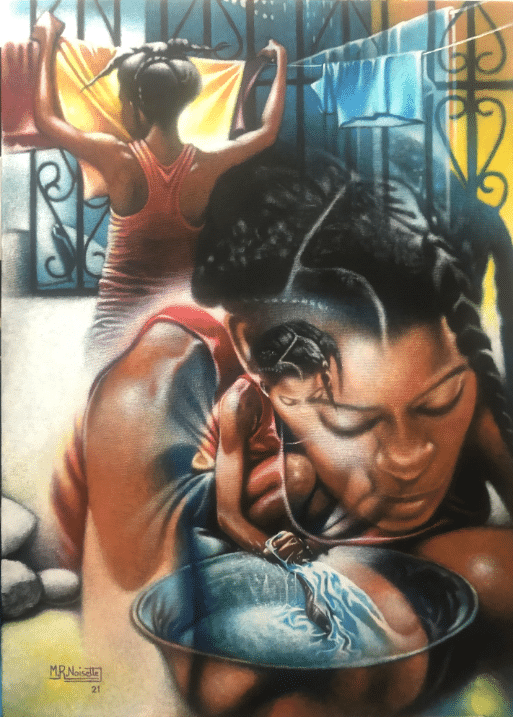
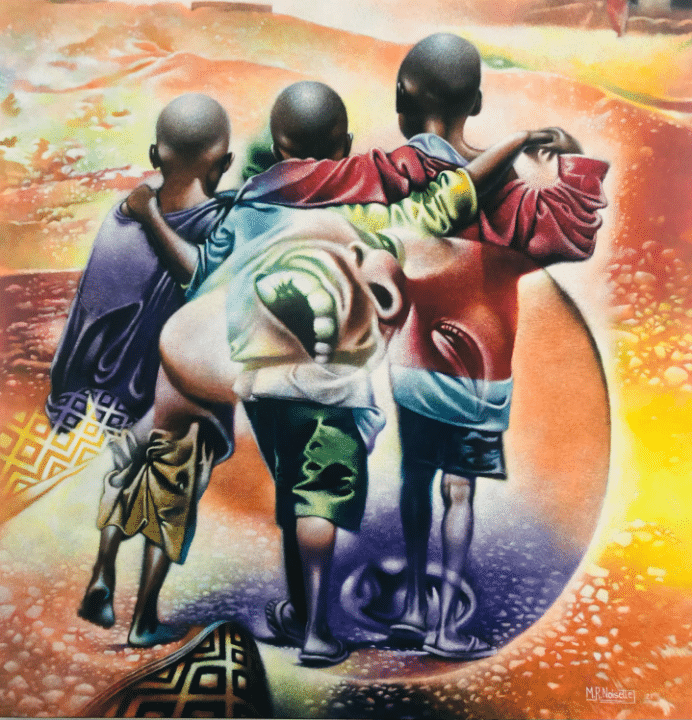
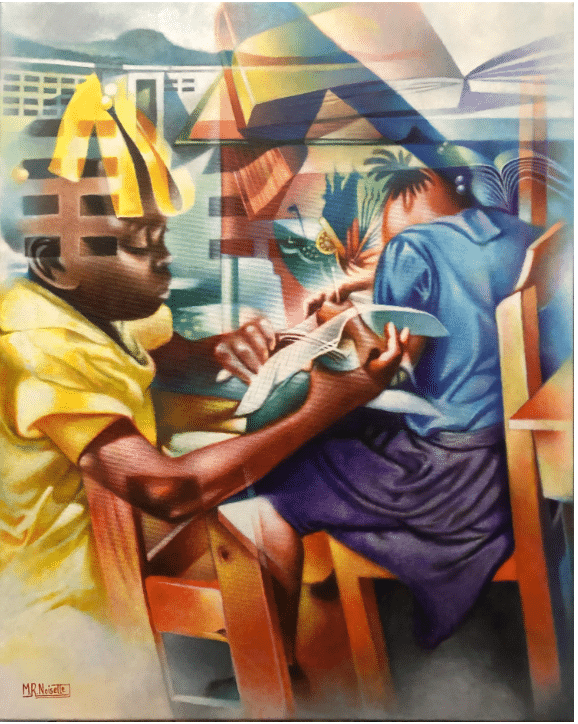
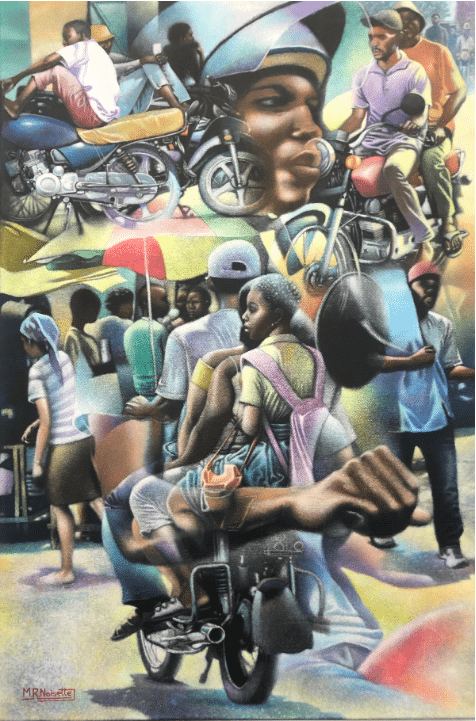
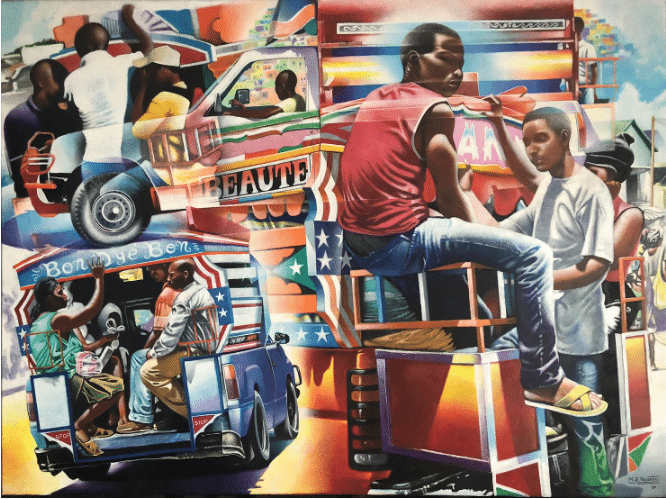
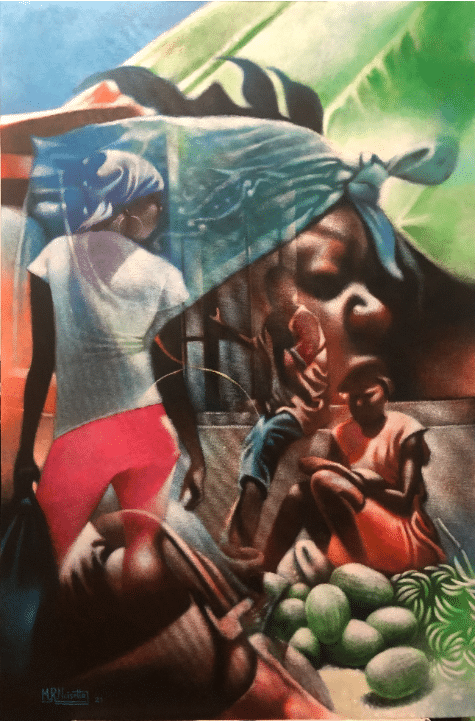
I discovered Michel Réginald Noisette on an online art platform. What stopped me was the remarkable realism of his paintings—the precision of his figures, the richness of everyday scenes, and the unmistakable sense of life running through them.
I wanted to know who was behind the work.
That curiosity eventually led to a phone conversation with Michel, during which I discovered that the story behind the paintings was as compelling as the paintings themselves. It is a story that begins in Haiti, passes through years of artistic silence and migration, and eventually returns to the place where it all started: the canvas.
A talent recognized early
Born in Port-au-Prince, Haiti, in 1976, Michel showed an affinity for drawing from childhood. His parents quickly recognized that this was more than a passing interest.
As a young student, he repeatedly distinguished himself in drawing competitions, earning awards and first prizes. Seeing his potential, his father decided to nurture it by giving Michel his first painting kit.
It was the beginning of a serious artistic education.
Michel studied with renowned Haitian painter Jacques E. Gourgues, who introduced him to the essential foundations of graphic art. Then, in 1994, after completing secondary school, he received more intensive training under Haitian master Roland Dorcely.
Dorcely expanded Michel’s technical vocabulary considerably, introducing him to classical Renaissance techniques as well as drawing in pencil, charcoal and pastel, and painting in both oil and acrylic.
Those formative years provided Michel with technique. What followed was the search for a voice of his own.
Finding his language
Michel’s most prolific period extended from 1993 to 2004, during which he created the majority of his early body of work.
Rather than settling into a single formula, he experimented with the different influences surrounding him. Gradually, a personal visual language emerged, grounded in figurative painting and particularly attentive to people within scenes of everyday life.
Then the paintings stopped.
Michel stepped away from his artistic practice to pursue architectural studies and follow another chapter of his life. Along that journey, he emigrated from Haiti to Canada, where he eventually settled permanently.
For years, the artist remained largely away from the easel.
But the distance from Haiti did not erase it from him.
The return
In February 2020, after a long interruption, Michel picked up his brushes again.
This return was not simply a continuation of what he had been doing years earlier. Time, migration and the experience of living between countries had changed the perspective from which he looked at his homeland.
Haiti now returned to the canvas through memory.
Michel began painting scenes from his country of origin—its people, daily rhythms and ordinary moments. Through his figurative language, these scenes become vessels for memory, resilience and the beauty of everyday Haitian life.
This reversal is particularly meaningful. Michel had physically left Haiti, yet painting became a way of travelling back to it. From Canada, his adopted home, he could preserve and reinterpret fragments of the country that had shaped him.
His work thus became a bridge between two territories.
Painting Haiti beyond its borders
That bridge is also connected to a much larger ambition.
Michel’s artistic dream is to introduce Haitian art—and, through it, Haitian culture—to audiences around the world, while ultimately earning his own place among the important figures of Haitian art.
It is an ambition rooted not simply in personal recognition, but in cultural transmission.
Perhaps this is what makes Michel’s return to painting particularly compelling. An artistic practice that could have remained a chapter of his youth has instead re-emerged with a new purpose. The boy whose parents recognized his talent, the young artist trained by Haitian masters, the architecture student who put his brushes aside, and the immigrant looking back toward the country he left behind all now inhabit the same canvases.
When I first encountered Michel’s work online, I saw accomplished figurative paintings.
After speaking with him, I began to see something more.
Every scene is also an act of remembrance—a way of keeping Haiti present across distance and time.
Today, Michel Réginald Noisette continues his artistic journey with his gaze turned both toward his roots and toward the future. Through his paintings, he continues to bring the scenes, faces, and memories of Haiti to life, driven by the desire to share this cultural richness far beyond its borders.
You can discover and acquire his work on Gallea at: https://www.gallea.ca/en/artists/michel-reginald-noisette-1
Location: Montreal area (Canada)